
“Biosecurity is sustainability,” said one producer during a discussion on how to make sustainable production methods more feasible. The conversation immediately shifted from better manure management or application timing and rates, and feed sourcing to protecting the health and welfare of animals. Each loss of an animal not only lowers profits for the farmer, but also means a loss of feed, energy, water, labor, land use, and care provided to an animal that doesn’t make it to market. Disease also reduces productivity, impairs reproduction, slows growth rates, and can cause discards of products due to food safety concerns (FAO, 2023). Ultimately, the lost production due to disease adds up to a larger environmental footprint. Disease outbreaks such as foot-and-mouth disease (FMD) or African Swine Fever (ASF) close international markets for all producers of susceptible species. The result is widespread economic and environmental losses.
The Environmental Footprint of Livestock Disease
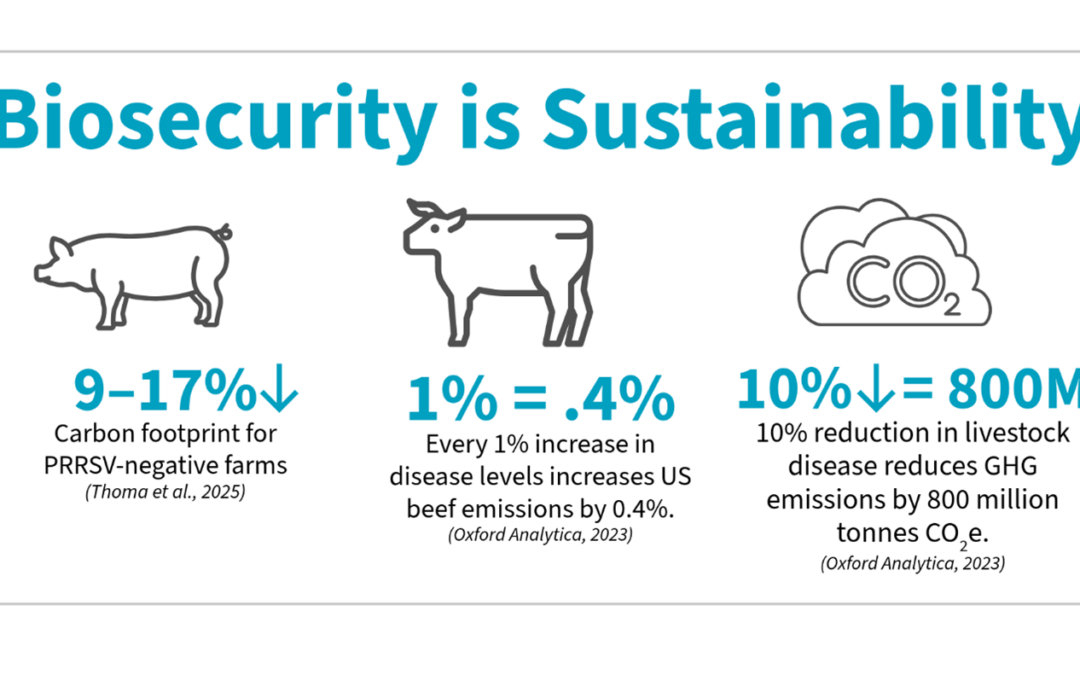
Thoma et al. (2025) used life cycle assessment, the science of measuring environmental impacts from production, to compare the greenhouse gas (GHG) impact of pig production with and without the presence of Porcine Reproductive and Respiratory Syndrome virus (PRRSV). They found that PRRSV-negative North American farms had a 4–6% lower carbon footprint than the North American industry average (a mix of PRRSV-negative and PRRSV-positive farms), and a 9–17% lower carbon footprint than PRRSV-positive farms (Thoma et al., 2025).
In the U.S. beef sector, every 1% increase in disease levels can increase agricultural animal sector emissions by 0.4% (Oxford Analytica, 2023). Globally, a 10% reduction in all livestock disease would reduce GHG emissions by an estimated 800 million metric tons of carbon dioxide equivalent (CO2e) (Oxford Analytica, 2023). For context, that footprint is the equivalent of the average annual emissions of 117 million people. Overall, reducing animal disease rates has the potential to lower global livestock GHG emissions by 18-30% (Oxford Analytica, 2023). As a result, we could potentially meet the animal protein needs for a global population of 9 billion by 2050 without increasing GHG emissions just by reducing the rates of animal disease.
Not surprisingly, diseases with high mortality rates have the most significant impact on GHG emissions from livestock production. Foreign animal diseases (FADs) such as FMD, highly pathogenic avian influenza (HPAI), or ASF can require a “stamping out” response strategy to mitigate disease. The strategy requires depopulation of an entire herd or flock and associated GHG emissions with carcass disposal, depopulation methods that use CO2 gas, and/or incineration.
GHG impact also increases as the prevalence of the disease increases. At a 5% prevalence, FMD in a dairy increases the CO2e emissions per kg of milk by 1.11%, compared to a 10.0% increase in CO2e per kg milk at a 45% prevalence (Capper, 2023). PRRSV in swine production varied from a 4.5% increase in CO2e per kg meat at a 10% prevalence, to a 34.9% increase at a 60% prevalence (Capper, 2023).
About 68% of U.S. dairy herds have at least one cow that tests positive for Johne's disease, an infection of the small intestine that affects cattle, sheep, goats, and other ruminants (USDA APHIS, 2025). According to the Capper (2023) study, Johne’s disease increases the GHG impact of milk by 25% per kg and beef by 40% per kg of beef due to the disease’s long-term effects on feed efficiency and growth before premature culling.
The potential impact of disease on GHG emissions also varies by species of animal. For example, a bovine disease would have a larger impact than a poultry disease, with the loss of the same number of animals (Oxford Analytica, 2023).
Economic Costs of Livestock Disease
Globally, an estimated 20% of livestock production each year is lost to disease (Osemeke et al., 2025). The lost production has a value of $358.4 billion per year, a figure that doesn’t include the human cost from the spread of animal disease. In the U.S., the pork industry has annual losses of $1.2 billion due to PRRSV alone (Osemeke et al., 2025). A low estimate of losses from the African Swine Fever outbreak in China, 150–200 million animals infected, was equivalent to the annual protein consumption of 403–538 million people in the country (Capper, 2023).
Producers’ ability to adopt sustainable practices requires evaluating the upfront financial costs and lack of market compensation for a more sustainable product against any long-term benefits. As a result, financial pressure on the agriculture sector coupled with thin margins means sustainability initiatives take a back seat to staying in business.
Similarly, producers must weigh the costs of biosecurity infrastructure development and upkeep, personnel training, and operating costs against the perceived risk of contracting disease (Merrill et al., 2019). It can be hard to quantify the return on investment for effective biosecurity, as this can require a counterfactual assumption—an estimate of loss that would have occurred if there had been a disease outbreak. However, biosecurity measures are linked to healthier, more productive animals and fewer mortalities, which has a direct and meaningful impact on a farm’s bottom line.
Biosecurity as a Lever for Sustainability
Manure and feed are the largest contributors to livestock production’s environmental footprint (Grossi et al., 2018; Gislason et al., 2023). Thus, most sustainability interventions focus on manure management and feed sourcing. Other facets of production, including infrastructure, reflect a much smaller portion of the footprint. For example, in pig production, energy use and transport contribute as little as 5% of the GHG footprint (Gislason et al., 2023). As studies like the Food and Agriculture Organization (2023), Oxford Analytica (2023), and Thoma et al. (2025) indicate, improvements to animal health outcomes reduce the sector’s global environmental impact, often by up to 18-30%. Biosecurity not only protects livestock well-being and farmer profitability, but it is also one of the most powerful levers to lower the environmental footprint of meat production. Increased farm profitability would also free up resources to address sustainability.
Co-Benefits of Biosecurity Programs
Effective sustainability programs are focused on outcomes such as cleaner water and reduced GHG emissions. Such programs can also produce co-benefits, additional positive outcomes that benefit society or the environment. Biosecurity programs not only reduce environmental footprints, but they support food security and One Health, the interconnection between animal, human, and environment health. Over 36% of emerging and re-emerging zoonotic diseases are associated with food-producing animals (WOAH, 2024). Protecting the health of livestock protects us all.
A Complete Solution for Biosecurity and Sustainability
SES has over 20 years of experience with foreign animal disease emergency management training, exercises, planning, and biosecurity program development. Our team has developed biosecurity training and auditing programs and supported producers in developing Secure Food Supply plans. We also offer life cycle assessment and sustainability consulting, supporting services that can help you quantify the environmental impact of your biosecurity program success.
References
Capper, J. L. (2023). The impact of controlling diseases of significant global importance on greenhouse gas emissions from livestock production. One Health Outlook, 5(1), 17. https://doi.org/10.1186/s42522-023-00089-y
FAO. 2023. Pathways towards lower emissions – A global assessment of the greenhouse gas emissions and mitigation options from livestock agrifood systems. Rome. https://doi.org/10.4060/cc9029en
Gislason, S., Birkved, M., & Maresca, A. (2023). A systematic literature review of life cycle assessments on primary pig production: Impacts, comparisons, and mitigation areas. Sustainable Production and Consumption, 42, 44–62. https://doi.org/10.1016/j.spc.2023.09.005
Grossi, G., Goglio, P., Vitali, A., & Williams, A. G. (2018). Livestock and climate change: impact of livestock on climate and mitigation strategies. Animal Frontiers, 9(1), 69–76. https://doi.org/10.1093/af/vfy034
Merrill, S. C., Koliba, C. J., Moegenburg, S. M., Zia, A., Parker, J., Sellnow, T., Wiltshire, S., Bucini, G., Danehy, C., & Smith, J. M. (2019). Decision-making in livestock biosecurity practices amidst environmental and social uncertainty: Evidence from an experimental game. PLoS ONE, 14(4), e0214500. https://doi.org/10.1371/journal.pone.0214500
Osemeke, O., Silva, G. S., Corzo, C. A., Kikuti, M., Vadnais, S., Yue, X., Linhares, D., & Holtkamp, D. (2025). Economic impact of productivity losses attributable to porcine reproductive and respiratory syndrome virus in United States pork production, 2016–2020. Preventive Veterinary Medicine, 244, 106627. https://doi.org/10.1016/j.prevetmed.2025.106627
Oxford Analytica. (2023). Animal health and Sustainability: A Global Data Analysis. https://healthforanimals.org/wp-content/uploads/2023/07/Animal-health-and-Sustainability-A-Global-Data-Analysis-July-23.pdf
Thoma, G. J., Pantoja, L. G., Linhares, D. C. L., Silva, A. P. S. P., Case, L., & Knap, P. W. (2025). The effects of PRRS on the environmental impact of pig production: a life cycle assessment study. Frontiers in Veterinary Science, 12, 1625581. https://doi.org/10.3389/fvets.2025.1625581
USDA Animal and Plant Health Inspection Service. (2025, July 30). Johne’s Disease. Animal and Plant Health Inspection Service. https://www.aphis.usda.gov/livestock-poultry-disease/cattle/johnes
WOAH - World Organisation for Animal Health. (2025, October 21). Policy Brief: The Importance of the One Health Policy Brief Approach in Tackling Emerging and Re-emerging Zoonotic Epidemics and Pandemics, The animal health perspective. https://www.woah.org/en/what-we-do/global-initiatives/one-health/
[1] Based on 6.8 tonnes of CO2e emitted per person each year.